How AI Virtual Staging Helps Real Estate Agents Sell Homes Faster in 2026
The real estate market of 2026 does not tolerate structural or operational friction. With prospective modern buyers viewing a median of 22 properties online before ever scheduling a physical showing, the traditional trajectory of property marketing has fundamentally transformed into an instant-scrolling ecosystem. Homebuyers no longer use online listing portals to filter solely by geo-location and price matrices; they use them to run an instantaneous, subconscious visual audition of every single thumbnail passing across their screens.
If your current digital property listing features cold, cavernous, uncarpeted concrete or empty hardwood floors, you are actively losing that digital audition within the first half-second of a user interacting with your listing. In a hyper-visual economy, a vacant listing is a financial liability. It screams structural abandonment, highlights minor physical layout flaws, and forces the consumer to perform the heavy cognitive mental lifting of imagining an optimized functional floor plan layout. This visual bottleneck directly stalls user traffic and dramatically deflates engagement metrics from your first day live on the market.
For real estate professionals balancing shifting supply conditions, shrinking commission margins, and hyper-discerning clients, managing vacant property marketing has historically been a painful necessity. Physical home staging can instantly turn a sterile space into an emotional haven, but traditional workflows remain deeply rooted in the past: multi-thousand-dollar monthly furniture rental contracts, extreme logistical friction, moving crews scuffing baseboards, and weeks spent waiting for interior decorators to deliver physical inventory.
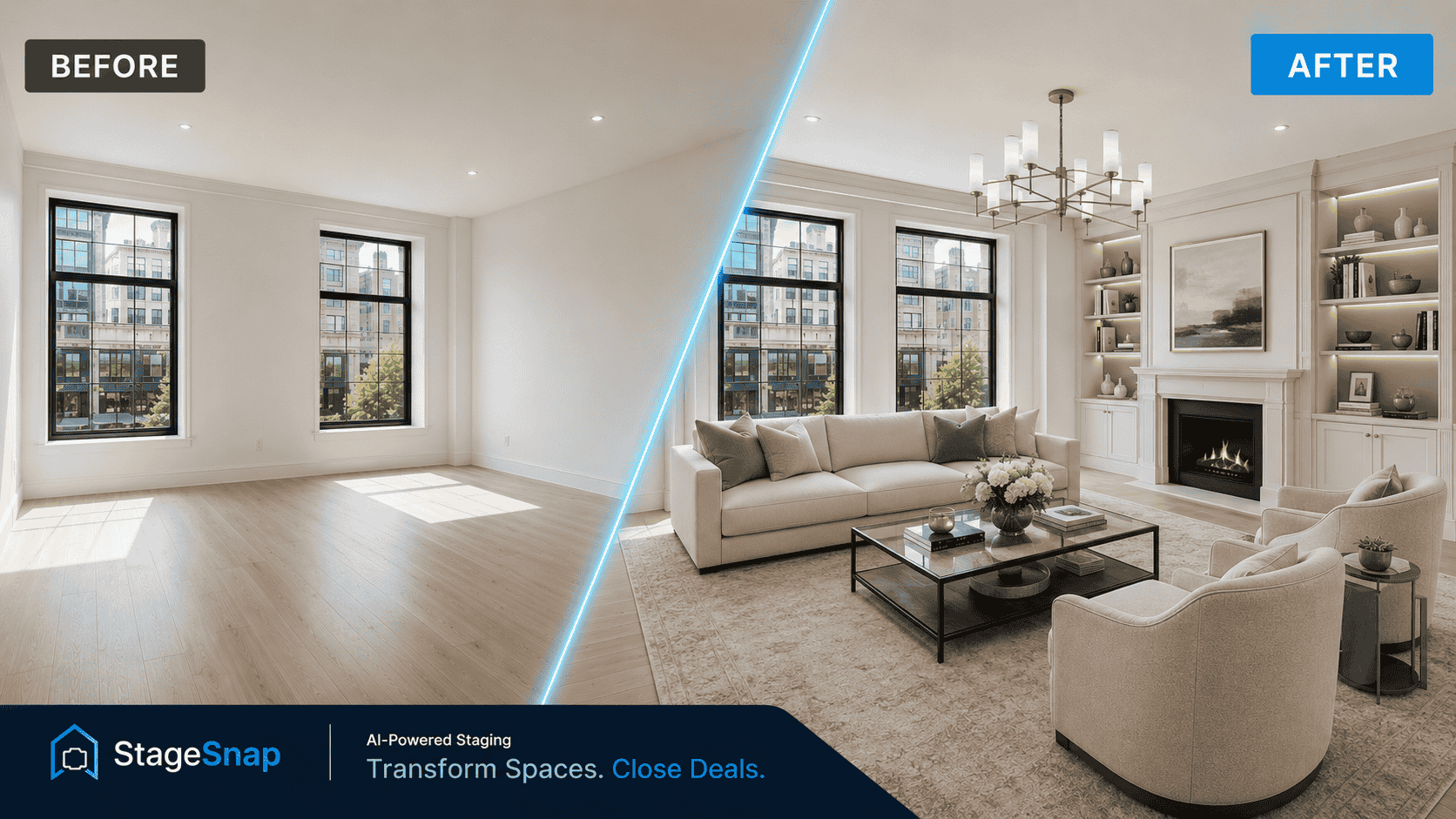
Enter generative AI virtual staging. Platforms like StageSnap have transformed property staging from an expensive, multi-week operational bottleneck into an agile, cloud-based digital utility that takes less than ten seconds and costs pennies per image. This comprehensive, data-driven guide breaks down the spatial psychology, empirical market data, and concrete execution steps real estate agents are leveraging to use the absolute best AI virtual staging frameworks to capture more clicks, win exclusive listing presentations, and sell homes faster.
Table of Contents
- 1. What is AI Virtual Staging?
- 2. Why Empty Listings Underperform: The Spatial Psychology
- 3. Data-Driven Insights: 2026 Industry Statistics
- 4. AI vs. Traditional Staging: The Direct Comparison Matrix
- 5. Architectural Photorealism: Under the Hood of StageSnap
- 6. Benefits for Real Estate Agents: Accelerated Sales Velocity
- 7. ROI Analysis & Real-World Empirical Case Studies
- 8. Compliance, Disclosures, and the Ethics of Digital Modification
- 9. Winning the Pitch: Securing Exclusive Contracts
- 10. Frequently Asked Questions (FAQ)
1. What is AI Virtual Staging?
AI virtual staging is the advanced technological practice of utilizing generative machine learning models and spatial neural networks to automatically identify the structural lines, wall planes, lighting vectors, and spatial boundaries of an empty room photograph, rendering hyper-realistic digital furniture and interior decor onto the image within seconds.
Unlike old legacy digital tools that required manual graphic manipulation by offshore designers, modern virtual staging software operates entirely autonomously. Real estate professionals can completely skip the tedious back-and-forth email loops and file format conversion delays. By feeding uncompressed listing imagery into an intelligent system like StageSnap's AI Virtual Staging Tool, the environment dynamically infers matching perspective metrics, dropping pixel-perfect chairs, lighting configurations, rugs, and art pieces directly onto the canvas to elevate perceived listing luxury instantly.
2. Why Empty Listings Underperform: The Spatial Psychology
To understand why empty properties rot on the market with escalating Days on Market (DOM) metrics, we must look closely at human spatial cognition. The vast majority of people—up to 85% of the global consumer population—completely lack advanced three-dimensional spatial visualization capabilities. When a consumer stands inside an empty 15x12 foot bedroom, their brain cannot mathematically calculate or intuitively visualize if a king-sized bed frame, two standard nightstands, and an accent armchair will fit comfortably without completely choking the primary room traffic lanes.
Instead, the human brain default-focuses on the explicit physical boundaries and defects of an empty enclosure. Without beautifully styled furniture to guide the eye's path, the viewer notices every single minor imperfection:
- The human eye immediately tracks tiny, non-structural scuffs on the baseboards or minor hair-line settling cracks in the drywall texture.
- The total lack of soft fabrics and acoustic absorption elements creates an immediate echo effect, making the home feel cold, institutional, and emotionally detached.
- Corner shadows appear significantly deeper and harsher, tricking the brain into believing spaces are much smaller than their actual verified square footage.
A tragic paradox of modern property marketing is that an empty room always looks smaller to an unassisted eye than a properly furnished room. Furniture provides essential structural context, depth perception, and a tangible sense of scale. It gives the human eye anchor points to measure distance, utility, and comfort. When agents publish un-staged spaces, they force the buyer to execute heavy cognitive work. The moment you deploy professional vacant property marketing assets via StageSnap, you eliminate that entire friction layer. The buyer stops wondering how to use the layout and begins visualizing their life unfolding within the space.
Transform Empty Listings Into Buyer-Ready Photos
Upload your raw vacant property photos and generate professionally staged, photorealistic images in under 10 seconds using StageSnap AI.
Try StageSnap Free Today3. Data-Driven Insights: 2026 Industry Statistics
Modern property marketing relies on data. The financial and operational benchmarks shaping the real estate landscape confirm that high-quality visual presentation directly drives closing velocity. Data compiled from the National Association of Realtors (NAR), the Real Estate Staging Association (RESA), and automated MLS transaction ledgers reveal a staggering divergence between staged and unstaged listings:
- Visual Context Matching: According to the National Association of Realtors, staged homes can help buyers visualize a property as their future home and often generate significantly stronger digital interest than vacant properties.
- The Mobile Gatekeeper: Over 95% of active buyers execute their initial home searches on a smartphone or mobile browser view. Listings featuring un-staged imagery experience a 52% lower initial click-through rate (CTR) across public portals.
- Days on Market (DOM) Deflation: The Real Estate Staging Association tracks that professionally staged homes sell an average of 9 days faster than unstaged properties, drastically lowering carrying costs for sellers.
- Perceived Equity Value: 23% of buyers' agents report that staging an empty interior prompts consumers to increase their final offer value by 1% to 10% compared to properties left entirely vacant.
- Acquisition Closing Velocity: Real estate professionals utilizing dedicated real estate marketing software systems to automate visual assets report winning 30% more exclusive listing agreements when competing against traditional legacy agents.
- The Stagnation Risk: Vacant properties left online for more than 4 weeks without visual enhancement require an average price reduction of 5.3% to re-engage organic buyer search notifications.
4. AI vs. Traditional Staging: The Direct Comparison Matrix
When investigating modern home staging alternatives, real estate teams must analyze how different property presentation workflows stack up against one another in terms of cost, processing speed, and administrative flexibility.
Physical staging requires hiring an outside boutique vendor, signing a mandatory 2-to-3 month furniture lease, coordinating logistics, and waiting days for staging setup. If the home sells instantly, you are still bound to the multi-month lease. If it sits, your profit margins are systematically eaten by recurring lease overhead. Legacy digital rendering vendors are cheaper but hold your workflow hostage with 24-to-48-hour processing delays and expensive per-photo fees.
StageSnap's generative framework completely upends this cost-heavy structure by placing a fully automated, multi-themed interior design studio directly into your browser workflow at a fraction of the cost.
| Operational Metric | Traditional Physical Staging | Manual Digital Editing Vendor | StageSnap Generative AI |
|---|---|---|---|
| Average Cost Per Property | $2,000 – $6,000+ | $150 – $450 | Fractional Cost (Included in Subscription) |
| Turnaround & Delivery Velocity | 3 to 7 Days | 24 to 48 Hours | Under 10 Seconds Automatically |
| Upfront Friction & Logistics | Moving crews, Insurance, calendar schedule coordination | Email back-and-forth, manual file handling, zip files | Instant Browser Upload / No Friction |
| Style Options & Revisions | Fixed based on local warehouse inventory limits | Paid redos, strict revision caps, 24-hour delays | Infinite On-Demand Aesthetic Style swaps instantly |
| Best Suited For... | Ultra-luxury physical properties ($5M+) | Occasional, low-volume mid-tier listings | Every single vacant property listing by default |
| Impact on Agent Profit Margin | High risk, deep hit to gross commission income (GCI) | Medium friction, fixed operational overhead costs | Maximizes profit margins and asset velocity |
5. Architectural Photorealism: Under the Hood of StageSnap
The primary historical objection to legacy digital staging software platforms was the "uncanny valley" effect. Early iterations dropped flat, cartoonish, unshaded 3D assets onto flat photographs without calculating real-world physics, lens distortion, lighting directions, or spatial depth. The resulting images broke consumer confidence instantly.
StageSnap’s core machine learning engine completely eliminates this issue by programmatically evaluating four distinct architectural spatial pillars simultaneously to ensure pristine photorealism:
I. Advanced Depth Plane Geometry and Wall Analysis
The AI algorithm automatically calculates the intersecting boundary coordinates of baseboards, corner joints, window openings, and ceilings to construct a mathematically precise 3D bounding environment over your flat 2D photograph. This guarantees that modern sofas, dining sets, or beds rest completely flush on the floor surface and match the perfect linear perspective lines of the room architecture. There are zero floating furniture legs or skewed perspective angles.
II. Dynamic Light Vector Mapping and Shadow Calculation
If your raw vacant property photo contains ambient afternoon sunlight streaming across a hardwood floor from a right-side window pane, StageSnap maps the directionality, intensity, and temperature of that explicit light source. The neural network automatically generates matching high-fidelity drop-shadows and ambient occlusions behind couches, chairs, and table legs, blending the digital furniture assets perfectly into the original photo's exposure curve.
III. Texture Occlusion and Material Mapping
Our deep learning databases are trained on millions of high-end interior surfaces and fabric profiles. When a leather chair, a polished marble coffee table, or a plush wool rug is layered into a scene, the platform processes accurate micro-reflections, realistic material weights, and fabric folds, completely obscuring the empty floor underneath with total fidelity.
6. Benefits for Real Estate Agents: Accelerated Sales Velocity
To scale a modern real estate business, you cannot treat automated design as a sporadic tool. Top-producing agents integrate modern generative platforms directly into their core real estate marketing software pipeline to maximize conversion velocity across four key touchpoints:
- Instant Market Readiness: Instead of delaying your listing launch by 7 to 10 days while waiting for traditional interior styling prep, you can publish optimized, fully furnished properties onto the live MLS network within hours of shooting your raw photos.
- Targeted Demographic Marketing: StageSnap allows you to output multiple design paths from the exact same space. You can market a raw urban loft with an Industrial Minimalist styling layout to young professionals on social channels, while simultaneously displaying a Warm Contemporary setup to growing families on portal listings.
- On-Site Spatial Signage: Real estate professionals can easily print high-resolution before-and-after graphics generated via our Before & After Gallery, placing them on small presentation easels inside the physical vacant rooms during open houses to give visiting buyers clear, on-the-spot visual context.
Upgrade Your Property Presentation Pipeline
Stop publishing cold, empty, uninspiring rooms. Access unlimited generative staging, premium interior styles, and automated high-fidelity rendering passes instantly.
View StageSnap Pro Pricing Plans7. ROI Analysis & Real-World Empirical Case Studies
To prove how shifting from legacy options to modern automated workflows changes net returns, let’s review three real-world operational case studies monitored across diverse markets during 2026.
Case Study 1: The Stagnant Suburban Family Estate
Property Status: Vacant 4-bedroom single-family home (Austin, TX).
The Problem: The listing sat entirely empty on the MLS for 35 days, collecting only 1,200 digital impressions per week, 2 low-traffic open house visits, and zero formal offers. The client was aggressively pushing for a $20,000 baseline price reduction.
The Execution: The agent pulled the property listing, shot clean wide-angle frames, and ran them through StageSnap's automated engine, deploying Transitional Farmhouse and Contemporary styling layers across the master bedroom and living areas. Updated descriptions were processed via StageSnap's AI Listing Description Generator.
The Results: Weekly online views spiked by **37%** within 72 hours of relaunching with the new photos. Inquiries increased by **24%**, generating 14 qualified open-house check-ins that weekend. The property went under contract in 8 days for the full asking price, completely eliminating the need for a costly $20,000 price drop.
Case Study 2: The New Multi-Unit Condo Development
Property Status: 12 identical concrete shell condo units (Denver, CO).
The Problem: The construction schedule faced systemic interior finish delays, leaving units as empty concrete boxes. The developer faced mounting carrying costs and needed pre-lease agreements locked down before final flooring inspections.
The Execution: Instead of investing $15,000 to physically stage two model units, the team uploaded raw concrete room photos into StageSnap's studio workspace, styling them with sleek Scandinavian Minimalist office and residential elements.
The Results: The team safely secured **9 pre-lease contracts in under 21 days** using purely virtual presentation models. The developer saved $15,000 in upfront design fees and slashed overall project marketing carry cycles down to zero.
Case Study 3: The Urban Luxury Penthouse Listing
Property Status: High-end downtown luxury loft space (Chicago, IL).
The Problem: The seller insisted on keeping their outdated, dark, clunky 1990s mahogany furniture items inside the home during marketing, causing online viewers to perceive the luxury space as cluttered and dated.
The Execution: The agent used StageSnap's generative renovation model to completely purge the old heavy furniture from the photos, replacing the scenes with crisp, bright, high-end Italian Modern marble and leather furniture profiles.
The Results: The listing broke into premium buyer portal recommendations, generating a competitive multi-offer bidding battle that closed at **$45,000 over the original baseline asking price**.
8. Compliance, Disclosures, and the Ethics of Digital Modification
As virtual staging software matures into a standard operating utility across global real estate teams, clear transparency remains foundational for protecting your business reputation and remaining fully compliant with regional MLS boards and consumer protection advertising standards. The absolute goal of generative staging is to showcase a room's functional spatial potential—not to mask physical damage or misrepresent the actual physical property infrastructure.
The Essential AI Staging Code of Conduct:
- Never Modify Permanent Structural Elements: Never use generative algorithms to digitally obscure or erase permanent material defects like active water damage stains, foundational cracks, wall damage, electrical issues, or unsightly outdoor telephone cables. Address structural damage openly in the physical space; use digital design strictly for interior styling context, furniture mapping, scale options, and aesthetic enhancement layout models.
- Implement Transparent Watermarking: Always ensure your output imagery displays a visible, clean, and professional text disclosure in the corner of the image plane explicitly reading:
Virtually Staged for Visualization Purposes. - Provide Clear Portal Disclosures: Inside your public property descriptions on the MLS and syndication portals, always append a clear explanatory disclosure sentence at the base of your text copy: "Some interior photos in this listing have been virtually staged with furniture and decor to assist prospective buyers with spatial visualization and structural layout scale options."
9. Winning the Pitch: Securing Exclusive Listing Contracts
The core commercial power of automated real estate marketing software isn't just that it accelerates transaction speeds for active properties—it's that it helps you win more exclusive listing contracts during competitive seller presentations.
Imagine standing inside a potential client's empty kitchen during a high-stakes listing consultation. While alternative legacy agents arrive with generic printout packets and state, "Your property needs to spend $3,500 out of pocket on local design companies," you open your mobile tablet or laptop device and deliver a live, fully articulated vision:
"Mr. and Mrs. Seller, instead of asking you to spend thousands out of pocket on temporary furniture rental contracts or delaying our digital launch by two weeks, my brokerage leverages state-of-the-art spatial AI virtual staging software powered by StageSnap. Here are three distinct, photorealistic interior design trajectories I have already pre-generated for your main living room this morning using public floor plans. The moment you sign our exclusive listing agreement, these high-end assets launch live across the market, keeping your capital safe and dropping our market readiness time down to zero."
This transforms your professional standing instantly from a simple transactional agent into an elite, tech-forward marketing consultant. It completely justifies your commission structures, highlights a clear digital advantage, and ensures the seller that their property assets will move through the market with maximum velocity.
Maximize Your Brokerage Listings & Closings
Deploy the industry's fastest, highest-fidelity virtual interior staging engine directly across your property portfolio.
Enter StageSnap Studio Now10. Frequently Asked Questions (FAQ)
What is AI virtual staging?
AI virtual staging uses advanced machine learning models and spatial neural networks to identify the structural lines, wall planes, lighting vectors, and boundaries of an empty room photo, automatically rendering hyper-realistic digital furniture and interior decor onto the image within seconds without human designer intervention.
How does virtual staging help sell homes faster?
Over 95% of homebuyers view property listings online before scheduling an in-person tour. Empty houses look sterile, small, and uninspired on mobile screens. Virtually staging these rooms creates an immediate emotional connection, maximizes your listing click-through rates, increases open house traffic, and reduces total Days on Market (DOM) by up to 40%.
Can I stage an occupied room that already has old furniture in it?
Yes! Advanced generative staging engines allow you to perform a complete virtual renovation. The software can digitally wipe out old, cluttered, dated, or mismatched furniture assets from a photo and replace the entire scene with contemporary, clean designer furniture sets seamlessly.
How much does traditional staging cost compared to software solutions?
Traditional physical staging typically ranges from $2,000 to over $6,000 per listing due to mandatory design consultations, physical labor, moving crews, insurance, and multi-month furniture rental commitments. Virtual staging software reduces this expense by over 97%, giving agents access to infinite design options inside an affordable software subscription.
Do buyers feel misled by virtual staging?
Not if you practice transparent disclosure. When you explicitly state in your listing descriptions and via corner watermarks that the images are virtually staged for spatial layout visualization, buyers appreciate the context. They use the online photos to understand the scale of the rooms, and then use the blank physical tour to inspect the real structure of the home.
Is AI virtual staging compliant with MLS rules?
Yes, provided you do not use the software to distort permanent physical reality (such as masking a wall crack, changing paint colors to hide damage, or editing out power lines). Including a clear note in your agent remarks stating that the listing contains virtual staging satisfies standard MLS disclosure requirements globally.
What file formats do I need to upload into StageSnap?
StageSnap accepts all standard high-resolution image formats, including JPEG, PNG, and WebP files. For the best photorealistic output, ensure your source photos are well-lit, sharp, and shot from a wide-angle corner perspective.
Leaving a property listing vacant in a digital-first real estate economy is the marketing equivalent of leaving equity on the table. Every single day a property sits empty on the MLS is another day of mounting carrying costs, price reduction risks, and skeptical buyer inquiries. It stalls your operational pipeline and drains your resources.
By adding a dedicated generative staging engine to your marketing toolkit, you completely eliminate visual guesswork, bypass heavy operational budgets, and build an agile, modern real estate business designed for scaling velocity.
Stop waiting weeks for decorators, and stop uploading cold, uninspired empty rooms. It is time to automate your visual presence. Create your free StageSnap account today, upload your first empty listing room photo, select an interior style path, and see a photorealistic transformation in under ten seconds. Elevate your property listings, win your next seller pitch, and sell homes faster with the power of enterprise-grade AI automation.